Posts

EU Inaction Threatens Vultures

Image
Despite proof that diclofenac kills vultures and other carrion feeders, the EU approved and continues to allow the use of this harmful veterinary drug. Despite the proven toxicity of this drug, the chemical company responsible, in full knowledge of its harmful impact on wildlife, continues to peddle and promote its use in Europe. Even more remarkable is Spain, under the guise of the Spanish Agency for Medicines, approved this harmful drug for use by veterinarians on pigs and cattle within Spain. Serious questions really need to be asked how this has happened? In December 2014 the European Medicines Agency (EMA) had published their long awaited technical position on the vulture-killing drug diclofenac, following a request from the European Commission, they confirmed that veterinary diclofenac does represent a real risk to European vultures, and therefore recommended that a number of risk management measures should be taken to avoid the poisoning of vultures, including more regulati...

Birds in Spain – Andalucia - Rüppell's Vulture

Image
Species: Rüppell's Vulture – Gyps rueppellii – Buitre Moteado Rüppell's Vulture juvenile note dark neck and head Polytypic. Nominate rueppellii , Sahel zone south of Sahara from Sénégal east to Sudan and south to East Africa, straggler Egypt. Extralimital : erlangeri , Ethiopia and Somalia. Rare visitor. Although a rare visitor, this species has, in recent times, become more commonly (annually) reported, especially in the area close to the Strait of Gibraltar. It is impossible to be clear on how many birds visit each year, due to lack of observer coverage. However, as recently as 2010, a brave attempt at an estimate puts the number at 8 or more individuals. Reports also have been made of an adult and juveniles being present throughout the year. Like many unusual bird sightings, the lack of coverage and people being on the lookout for the unexpected, has probably led to these vultures being overlooked. Here we give an identification aid, which we hope wi...

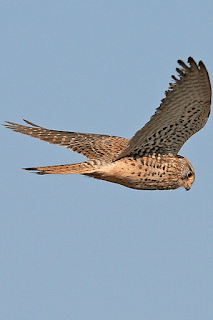
Birds in Spain - Andalucia - Common Kestrel

Image
Species: Kestrel – Falco tinnunculus – Cernícalo Vulgar Kestrel female Polytypic. Nominate tinnunculus , west Palearctic east to north-east Siberia, Mongolia, and Pamir; canariensis , western Canary Islands; dacotiae , eastern Canary Islands; neglectus , northern Cape Verde Islands; alexandri , south-east Cape Verde Islands; rupicolaeformis , Egypt south to northern Sudan, east to Arabia. Extralimital : c. 5 races in Africa and Asia. Common and widespread resident. Breeds over a wide range of habitats, even urban areas, although always requires open type spaces with some ground cover for feeding. Densities of population are clearly demarked by habitat type, for example the Doñana has very high population densities in areas of open grassland habits. Some increase in numbers during winter as migrants from the north join resident populations. Also migration can be witnessed in spring and autumn, thought only to involve populations from outside of the province. Especie:...

Birds in Spain - Andalucia - White Wagtail

Image
Species: White Wagtail – Motacilla alba – Lavandera blanca White Wagtail M.a.alba Polytypic. Nominate M.a.alba , continental Europe, Iceland, Faeroes, Asia Minor, and Levant, grading into dukhunensis in Urals, lower Volga basin, western Caucasus, and eastern Turkey; yarrellii ,Britain, Ireland, and locally on coasts of western continental Europe; subpersonata Morocco. Locally common breeding bird, but can be surprisingly scarce or even absent in some areas. Numbers greatly increase during late autumn and winter with the arrival of birds from northern Europe. During the winter the species is abundant and widespread. Our breeding population M.a.alba is thought to be resident; although it is likely some migrate the short distance into Morocco and possibly further south. Especies: Lavandera blanca – Motacilla alba – White Wagtail Politípica. Nomina M.a.alba , Europa continental, Islandia, Islas Feroe, Asia Menor y el Levante, la clasificación en dukhu...

Birds in Spain – Andalucia – Black Redstart

Image
Species: Black Redstart – Phoenicurus ochruros – Colirrojo Tizón Polytypic. P. o. gibraltariensis , western and central Europe east to Latvia and Crimea, south to northern Spain , Sicily , and Greece ; also north-west Africa and (probably this race) western Asia Minor; aterrimus , Portugal and southern and central Spain north to Valladolid . Common breeding species, restricted by suitable habitat. Larger breeding densities confined to and most common in mountain and rocky areas, some birds breed in urban areas. Resident race¹ P.o.aterrimus is joined by more northerly race P.o.gibraltariensis during periods of migration and winter, indeed our resident birds are frequently outnumbered by the visiting gibraltariensis . Occurs most commonly (abundant) and is widespread throughout the province in autumn and winter. ¹ Sources give P.o.aterrimus as sedentary. There is evidence however to suggest some of the population may migrate to Morocco during winter. During unus...

Disaster affects Greater Flamingos at Fuente de Piedra

Image
Greater Flamingo Pheonicopterus ruber ( Flamenco común ) Anyone fortunate enough to have witnessed the large flocks of Greater Flamingo at Fuente de Piedra cannot have failed to have been left with a lasting impression of wonder. Their pale colour suddenly transformed when outstretched wings reveal a deep and striking pink contrasting with their pale body colour and emphasised by black wing tips. Of course their size and unique shape make them instantly recognisable to almost all of us. Greater Flamingo first colonised Fuente de Piedra back in 1963 and has since made the area a star attraction for many visitors. With a maximum count of some 34,000 birds being present in the past then it is not surprising why many people want to make this area a ‘must see’ site during their stay in Andalusia. Since the first breeding in 1963 the lake and its attraction to wildlife in general has become increasing important to the local economy with many thousands of visitors coming specifically...

Spanish Trip Report from Mick

Spain including Majorca Trip Report - Spanish Nature – 5th April to 20th April 2008 Majorca – Extremadura – Doñana – Ronda – Granada Trip Report Author – Mick Richardson www.spanishnature.com Day One 5th April 2008. Salinas de Levante, Colonia San Jordi and Salinas Colonia San Jordi. Weather: Bright and sunny but windy later. After a swift and eventless pick up at Palma airport the five of us headed out south west via Campos to Salinas de Levante, an area of working and disused saltpans. We first parked just off the main road to Colonia San Jordi and walked down what is still known as Eddies Track (After Eddie Watkinson who first regularly watched the area). Just passed the buildings the first birds seen were a pair of Thekla Larks feeding on a rough field, other birds seen on the fields included European Stonechat, Barn Swallow, Corn Bunting, European Serin and European Greenfinch. We then moved out into the saltpans, most of which are disused along this track. The sides of the pans ...